
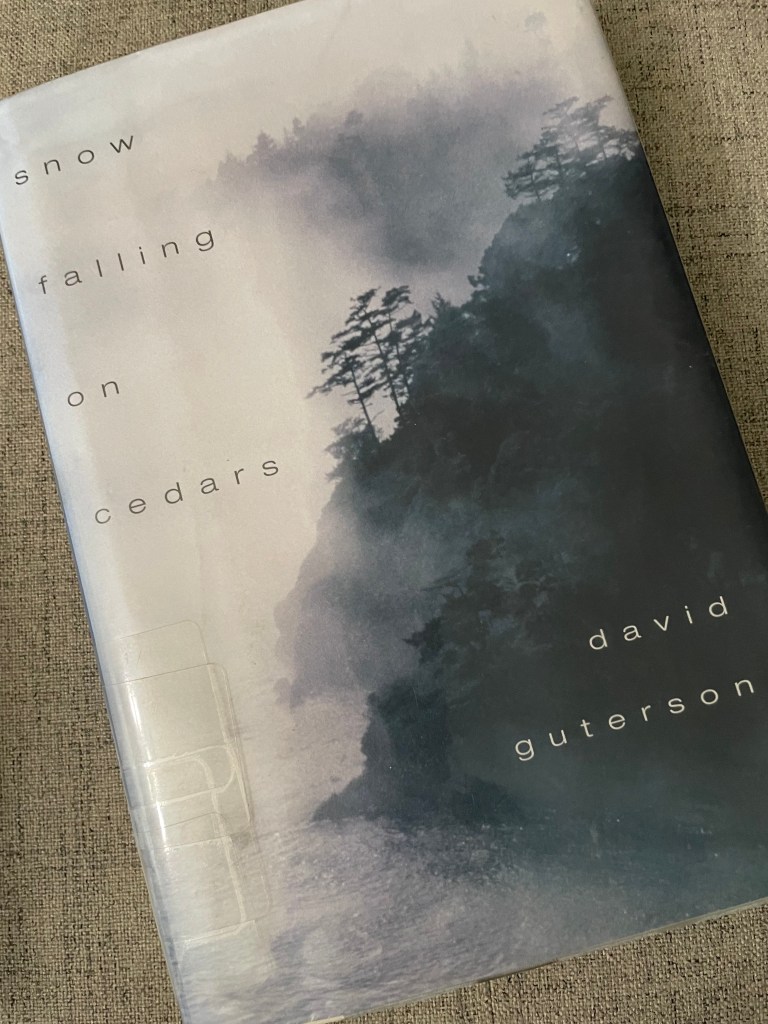
Recently, I read Snow Falling on Cedars by David Guterson. This book is wonderfully thoughtful, focusing on the trial of Kabuo Miyamoto for the murder of Carl Heine in 1954. Guterson centers racism, injustice, and social inequity in the small fishing village of San Piedro, an island in Puget Sound.
As I read the early pages, I marked a particular scene in which Kabuo is staring out the window, watching the snow fall on the trees. I mean, the book is titled Snow Falling on Cedars for a reason! As English teachers, we know that when the book’s title comes into play, we should take notice.
The book repeatedly returns to the snow throughout the trial, with various characters noting its beauty or potential meaning to them. Some have practical concerns: pipes freezing, getting home, etc. But Kabuo looks at it and realizes, as he watches the first snowfall of winter, that he has missed a whole season awaiting his trial.
“Snow fell that morning outside the courthouse windows, four tall narrow arches of leaded glass that yielded a great quantity of weak December light. A wind from the sea lofted snowflakes against the windowpanes, where they melted and ran toward the casements. Beyond the courthouse the town of Amity Harbor spread along the island shoreline. A few wind-whipped and decrepit Victorian mansions, remnants of a lost era of seagoing optimism, loomed out of the snowfall on the town’s sporadic hills. Beyond them, cedars wove a steep mat of still green. The snow blurred from vision the clean contours of these cedar hills. The sea wind drove from vision the clean contours of these cedar hills. The sea wind drove snowflakes steadily inland, hurling them against the fragrant trees, and the snow began to settle on the highest branches with a gentle implacability.

The accused man, with one segment of his consciousness, watched the falling snow outside the windows. He had been exiled in the county jail for seventy-seven days—the last part of September, all of October and all of November, the first week of December in jails. There was no window anywhere in his basement cell, no portal through which the autumn light could come to him. He had missed autumn, he realized now—it had passed already, evaporated. The snowfall, which he witnessed out of the corners or his yes—furious, wind-whipped flakes against the windows—struck him as infinitely beautiful.”  (page 2)
I’ve used many different passages to illustrate setting as a character before, and I think this passage could be used in that regard. It is a gentler, more subtle look at snow than the description of the house from “The Fall of the House of Usher” or the look Lee gives us about the town of Maycomb in To Kill a Mockingbird, and it has the potential for students to discuss snow as an archetype in general and a symbol in this context in particular.
- What do you think the snow symbolizes in this particular scene?
- How does snow function in the world of the archetype? Does Guterson uphold those archetypes, does he subvert them, or does he make them new in some way?
- What effect do the dashes have on the meaning of this passage?
- What is the organizational structure of this excerpt (i.e., chronological, spatial, etc.)? Why does Guterson use this structure in his description of the snow and Kabuo’s perspective?
- How are the courtroom and the outside world contrasted in this excerpt? What meaning does this contrast create?
- What major themes does Guterson develop in this passage?
- How does Guterson establish the world outside of the courtroom as a character in this excerpt?
- Reflective Prompt: Using Guterson’s passage as an example, describe a setting that has stuck with you. It could be somewhere meaningful, strange, beautiful, or even uncomfortable from your childhood, a place you’ve visited, or even something you encounter daily that you may appreciate. Use descriptive language and dashes to create effective stylistic choices, as Guterson does.
This would, of course, be one of my book recommendations for my students, and I would highlight this excerpt through a weekly bell ringer or an exit ticket to help them practice zooming in on particular passages. I would probably pair this with a short story or poem where the setting plays a significant role since students need to practice zooming in and zooming out in reading to enhance their takeaways. “Stopping by Woods on a Snowy Evening” by Frost seems like an obvious choice, but “Harlem” by Langston Hughes, “kitchenette building” by Gwendolyn Brooks, “Dusting” by Julia Alvarez, or “Sonrisas” by Pat Mora would be wonderful as well to reinforce the moves necessary for zooming in and out in a full text. Some nonfiction choices could be “38 Who Saw Murder and Didn’t Call the Police” by Martin Gansberg or “Salvation” by Langston Hughes, both of which focus on a place as a site of significant cultural constructions, understandings, and misunderstandings.
What poem or short text would you pair with this passage?
 Joyful Literacies
Leave a comment