
Sometimes it’s easy to forget the joy of teaching amongst the constant grind. When I forget, it’s because of one main thing—I’m doing more “administrative” tasks than I usually do. At the end of the semester, the administrative tasks seem to pile on and steal, frankly, some of my joy.
But I still feel the joy in my daily classes and in the moments of teaching. Like when a student accidentally squirts a stream of water across to another student’s desk, which startles the other student out of the trance my lecture (no matter how brief) has put her in. The water-bottle student inexplicably meant for the water stream to hit a strand of his own hair, which he was holding between two fingers in front of his eyes, and, when it missed, the tenth-grade boy whispered, “Whoopsie.” All while I was talking about narratives… Needless to say, I started laughing in the middle of my note-taking in front of the class, and the rest of the class—except for a few students who also witnessed it—were completely baffled by why. (That’s okay. I don’t mind it when they think I’ve lost my mind.)
But there’s also joy when I read the students’ quick personal narratives and get to see who they are more so than when they write an informative writing about a concept we assign—what they think, what they like, what they sometimes think about themselves, what they think about school. It reminds me of the power of the personal narrative, and I’m glad I’m ending my semester with the unit on narrative writing, with the intention of having students write a Common App essay next week that they’ll save in their Drives for their senior year when they get ready to apply to college.
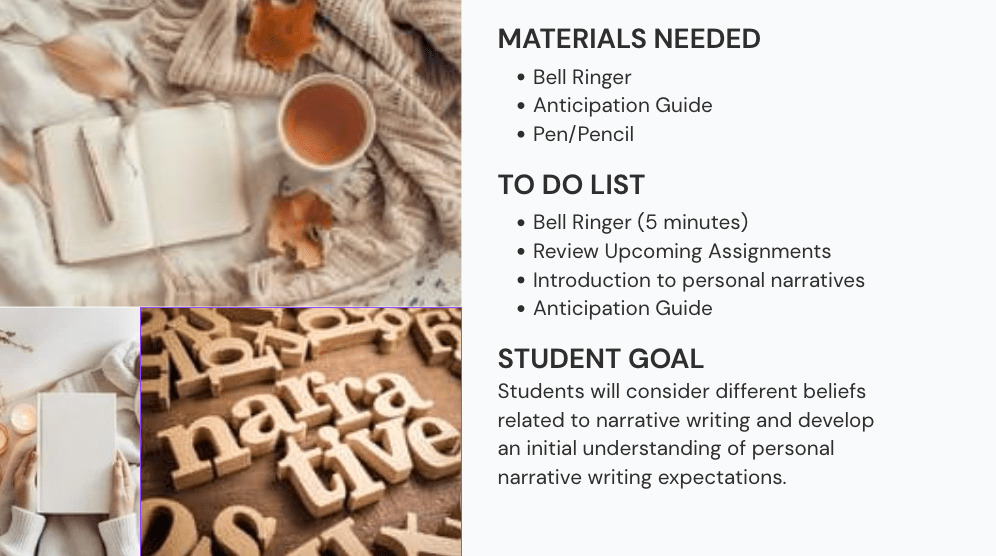
I first started with an anticipation guide, where I had students consider their beliefs about concepts related to personal narrative writing. I had students determine their answers, then move to different partners during a movable Think/Pair/Share. I did give them some advice on how to have the conversations (10th graders need the structure) and to ask follow-up questions. If I changed anything in this document, I would remove the “can’t decide” line. Only one or two of them chose it throughout the day, so it really was just there to look pretty. (But I could also be talked into keeping it, as it gives students an opportunity to help shape someone’s understanding and takeaways…hmm. Maybe I just convinced myself to keep it?)
In last week’s blog entry, I talked about how attending Kelly Gallagher’s session at NCTE led me to start the narrative unit with the list essay. I loved starting with this because it allowed students to consider the lessons they have learned as they’ve grown up. One of the most important elements of personal narrative writing for college applications is discussing the lessons the student has learned (check out this video for more on lessons learned in college personal narratives), so the list essay gave us an introductory lesson in this element. I got funny ones and serious ones and middling ones, but the one thing they had in common: they reflected who they are and what they know. And bonus! They will be able to use these as potential brainstorming material for their final essay drafts for their personal narrative.
As I’ve said before, I used some essays as mentor texts—Questlove’s “My Life in 27 Records,” a Medium article titled “Things I Learned at 14: A Pivotal Age” by Nolan (no last name given), Jason Reynolds’ “Ten Things I’ve Been Meaning to Say to You,” and Taylor Swift’s “30 Things I Learned Before Turning 30”—which we broke down for text-to-text, text-to-self, and text-to-world connections (email me if you want the documents I used for this).
Then, I gave them some time to brainstorm and write their list essays.
Once we had the lists done, we moved on to other elements: descriptive details, sensory details, structure, and dialogue. I’m not going to lie: I used AI to generate these definitions, which I think is a perfectly good use of AI as a teacher. I, however, did clean up the notes before giving them to the students and took clarifying notes under the document camera on the definitions as we talked through these elements. I also used Linda Rief’s book The Quickwrite Handbook: 100 Mentor Texts to Jumpstart Your Students’ Thinking and Writing (on loan from Katie!). I pulled mentor texts—a selection from Station Eleven by Emily St. John Mandel for descriptive writing, the poem “I’m From” by Linda Rief for sensory details, and “My Father’s Voice” by Tom Romano for structure and dialogue—for the narrative elements I wanted to review with the students. I had one for active voice as well, but I ended up working on that element through my bell ringers for the week. (Again, email me for the documents I used.)
After we reviewed the mentor text, I had the students write their own based on what they read and what the text brought to mind, a prompt I took directly from Rief’s book. (Seriously! This book was great! I highly recommend it for teachers to have on hand!) I had students writing about the end of high school based on the selection from Station Eleven, writing poems with sensory details about who they are based on Rief’s poem, and writing about a meaningful person in their lives, where I told them that they should use authentic, purposeful dialogue based on Romano’s reflection. I learned so much about my students from these flash narratives. (I only gave them 15-20 minutes to do the writing and practice the element.)
These flash narratives can also serve as the basis for their final essay, so everything they’ve been writing for me is brainstorming for that end goal. We start those next week, and I’ve pulled the prompts from Common App. I’m looking forward to getting started, seeing how this all comes together in the end, and experiencing the joy of supporting my students in their future endeavors and reading about their experiences—who they are and who they are becoming.
 Joyful Literacies
Leave a comment