
As an English teacher, I always have the best intentions when it comes to reading over summer break, but I rarely get through the entirety of the list. But this summer is different, I swear! 😂
I have separate lists for what I want to read for my classroom library, for my teaching, for myself—I have a nonfiction list, a professional text list, a fantasy/romantsy list (this seems to be the most popular genre amongst teens right now), and an literary fiction list. Maybe you see why I rarely get through my list in the two months I have before school starts again.
Today I’m going to focus on my nonfiction list:
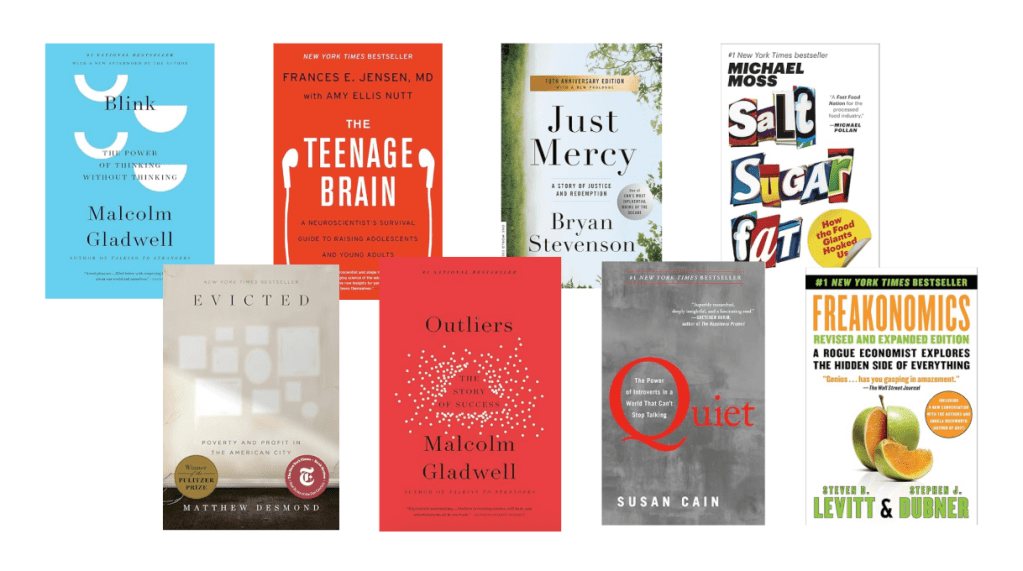
- Quiet: The Power of Introverts in a World That Can’t Stop Talking by Susan Cain
- The Teenage Brain: A Neuroscientist’s Survival Guide to Raising Adolescents and Young Adults by Frances E. Jensen with Amy Ellis Nutt
- Outliers: The Story of Success by Malcolm Gladwell
- Blink: The Power of Thinking without Thinking by Malcolm Gladwell
- Evicted: Poverty and Profit in the American City by Matthew Desmond
- Just Mercy: A Story of Justice and Redemption by Bryan Stevenson
- Salt, Sugar, Fat: How the Food Giants Hooked Us by Michael Moss
- Freakonomics: A Rogue Economist Explores the Hidden Side of Everything by Steven D. Levitt and Stephen J. Dubner
This list is a priority for me because I plan on having my students in AP Seminar read one of these books in literature circles at the beginning of the year to get them accustomed to the challenge of a class that focuses on nonfiction. There are eight options from which the students can choose, all of which I get to read (or re-read) in some cases, create close readings, and develop projects for the four weeks I’m going to have them read these. (For those of you wondering if I can pull this information from somewhere else I’ll say this: Teaching is not just a science of how students can regurgitate certain skills but an art where I get to create questions for students to consider deeply. To me, it’s the creative art of development that is the joy of teaching. My job is to open my classroom as a space of exploration and evaluation, which I do as I choose the works that my students will read and develop potential scaffolds/supports that support students’ thinking processes.)
While the lit circles will develop their own reading schedule, they will meet to discuss the book on Friday and have a few days after they finish to report on what they’ve learned as a group project.
In AP Seminar, each student writes a 1,200-word research report in the first semester on a topic that their group chooses, and the goal is for their lit circle book to lead them to a topic they can work on with a group. They’ll do a presentation together to report on their topic, but each group will choose a different lens (i.e., economic, political, psychological, artistic, scientific, etc.) to approach the same topic in their individual writing.
I’ve chosen my nonfiction list deliberately because each of these books focuses on broad topics and narrows to specific topics throughout the chapters, giving students several options for potential topics for their future papers. As I move through each book, I’m going to post my close readings for each on this Substack every few days for other teachers who may want to use these books themselves.
If you want to read along with me, I’m starting with Quiet by Susan Cain, which should be finished by the end of the week.
Happy reading and teaching to my fellow educators!
 Joyful Literacies
Leave a comment