Recently, I spoke with a former colleague not just about teaching but also about hiring. She said this: “It is hard to find real WRITING teachers anymore.”
The conversation stayed with me for a while, obviously. In recent research I did with preservice teachers, I noticed a pattern within their comments: They loved reading. This was almost universal, with few exceptions. They love all reading, from their days reading Percy Jackson to the classics their English teachers threw at them in their advanced and AP courses in high school. They had complaints about how they were taught, but their love of reading was a blatant reason they wanted to become English teacher—to spread their love of reading to others.
An admirable goal, to be sure. But, now, I can’t help but think that a conversation about being a writing teacher was necessary because secondary teachers are more writing teachers, analysis teachers, and inquiry teachers than reading teachers. By the time students get to us, they feel that they already know how to read, but what they really need to learn is how to write about their reading, how to take what they read and wrestle with it, how to pick up ideas and create inquiry pathways with them.
Here’s a story: I had 10th-grade students go to ninth-grade English classrooms to promote one of the writing courses I teach, which has low enrollment. The class can be used as an English credit, but it is a challenging course with a writing-intensive purpose that is research-based. As the students promoted the class, one said, “I chose this class because I felt that I was learning the same thing in English classes every year and wanted something different.”
This took me aback. I teach English courses as well, and I had to take a moment to really reflect on what the student was saying here–that her English class in ninth grade already felt repetitive to her. I teach 10th-grade English, and after she said that, I began to see the evidence of repetition everywhere–especially in the standards, which for my state, are more heavily reading-based than writing.
But isn’t writing really reading? Don’t we read the world and the word to create writing, to have an exigence for writing, to write ourselves and our ideas into the world?
I think so, which is why we need to focus more on writing in secondary school. And I don’t just mean formal writing, but all kinds–including podcast writing, informative video writing, PSA writing, comic writing, and, yes, more research-based essay writing–in the form of blending informational narratives with descriptive ideas or editorials that include exposition and narrative writing that feels more realistic and relevant than perhaps the five-paragraph essay does–that those who go to college will need. We can fit new modes where writing exists into our curriculums and into our classrooms, where students use what they are reading for their writing.
A friend of mine always says, “I’m a writing teacher.” This is part of her identity as a teacher. It’s a part of mine as well. But I have to wonder if it is a part of every English teacher’s identity, especially if good schools can’t find “real WRITING teachers anymore.”
Maybe these ideas are controversial, and maybe some will disagree with the idea that there aren’t enough writing teachers. I don’t know. But here’s what I do know: We can’t be joyful if we fail to teach our students how to express their ideas about reading the word and the world through their writing.
But the question is this: Where do we start? Personally, I think we should start by integrating writing into every day and every aspect of a unit. And not just in writing journals that are quickly abandoned or brushed off by students as “busy work.” Instead, we constantly return to ideas and have students revise and reconsider their writing through various lenses.
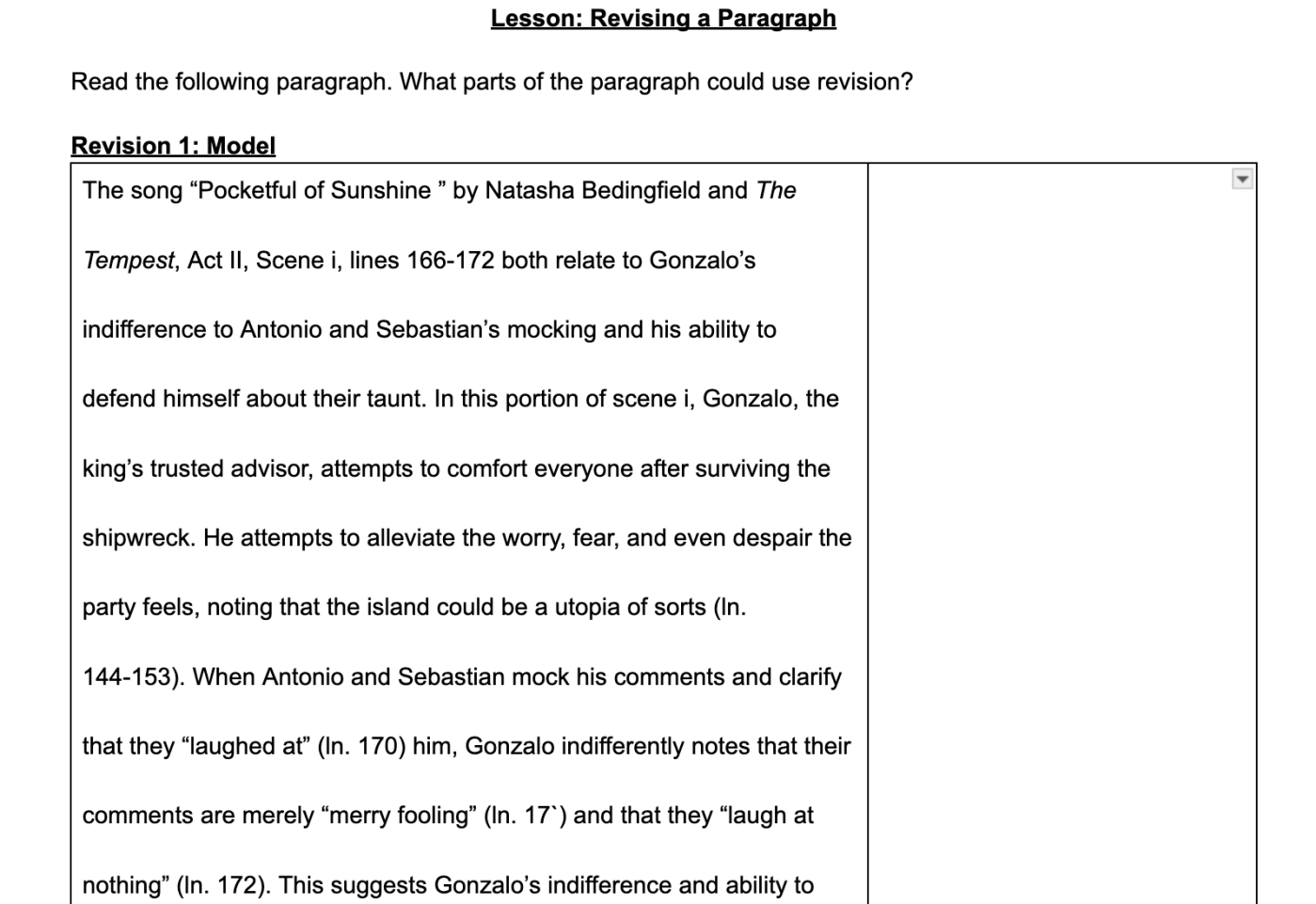
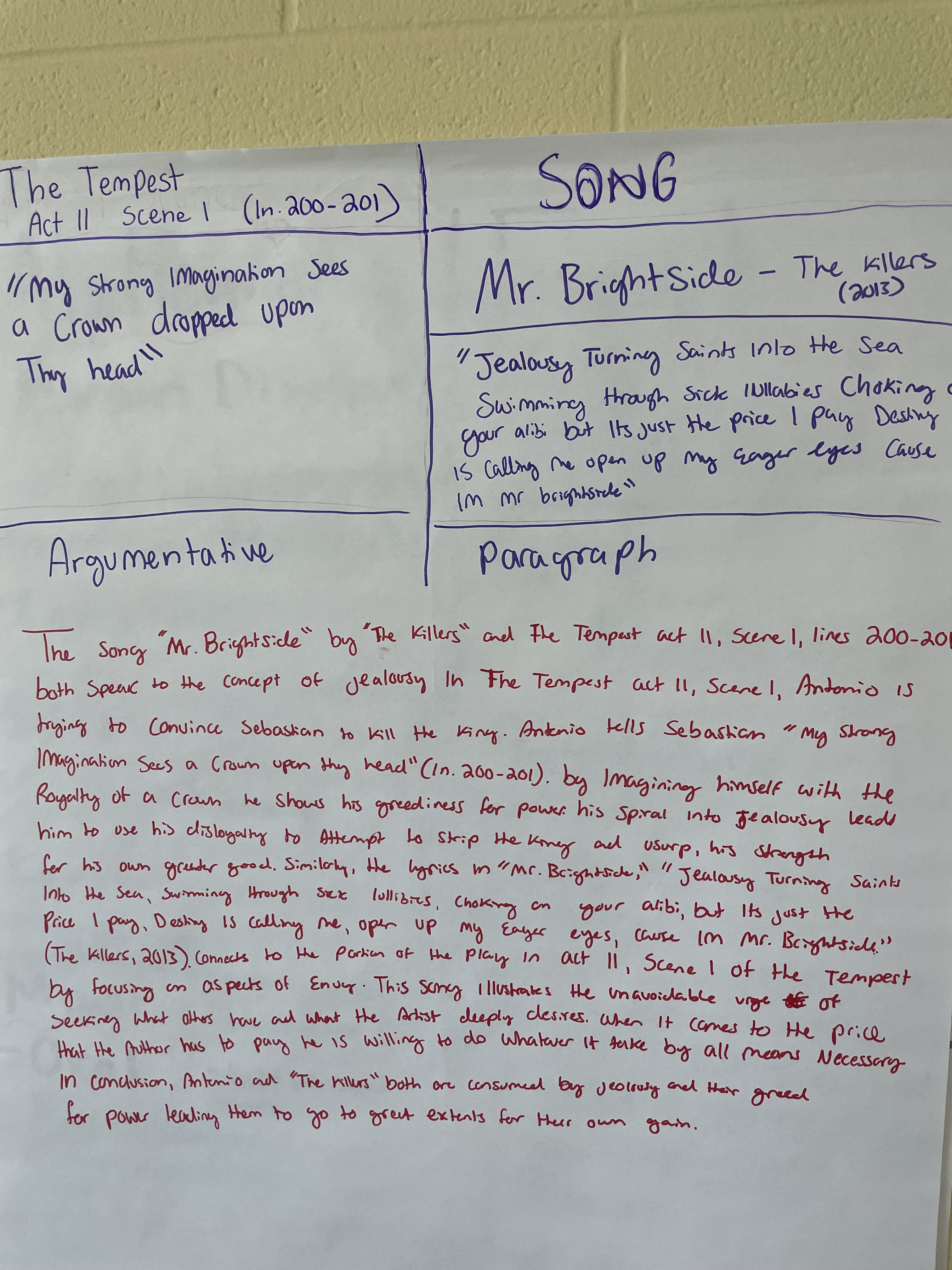
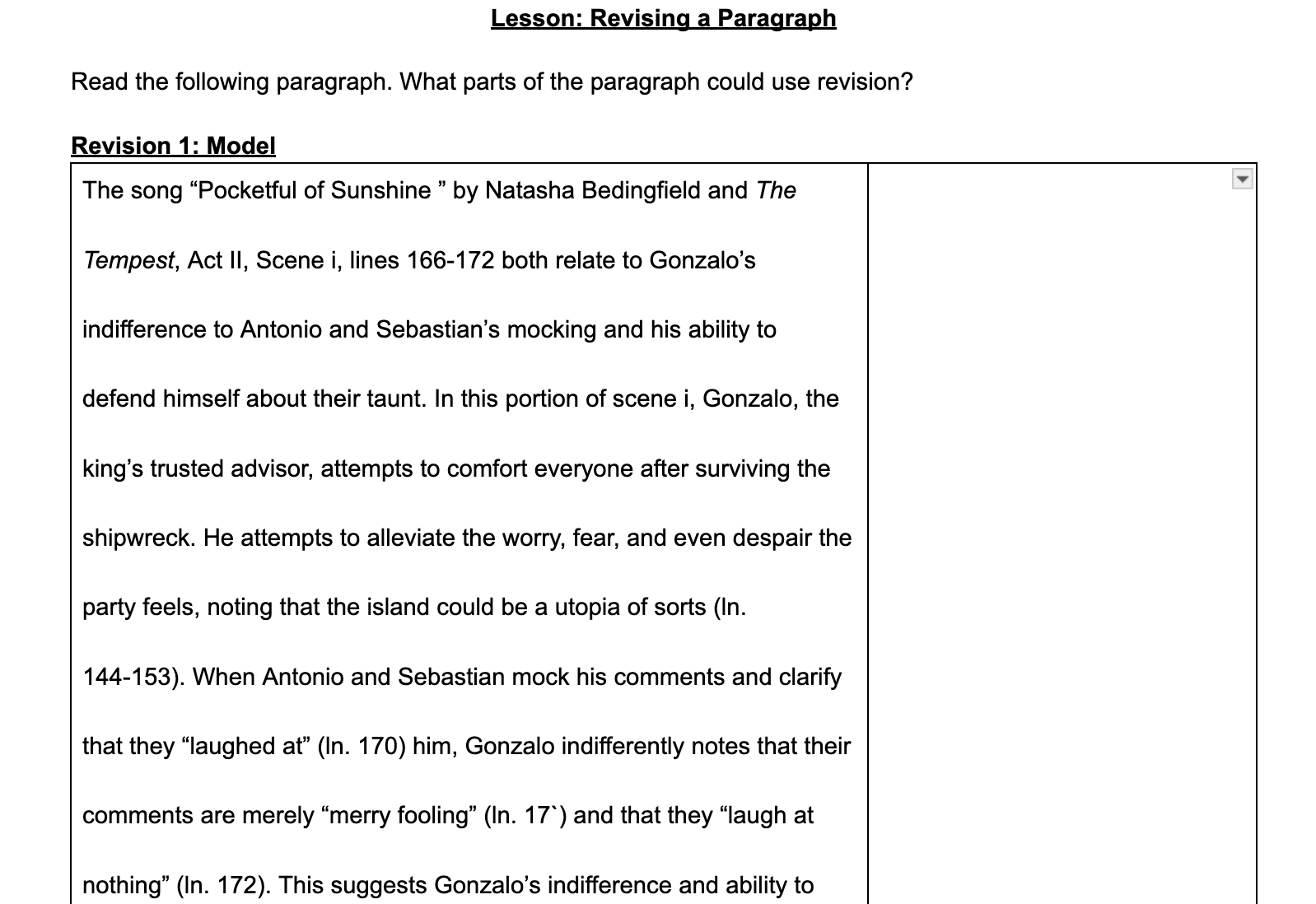
For me, I had to break down their writing by what they weren’t doing. In a recent lesson, my students did a collaborative paragraph where they had to choose a song that had a similar idea from a text we were reading. I noticed in their collaborative writing that they could interpret a text occasionally struggled with evaluating that text for meaning, at least in their writing. I had them consider two questions: What does their chosen evidence mean in the context? and What lesson do they take away about the human experience or the world from the evidence they chose? I’m not going to lie and say they are perfect now. But following the collaborative writing with a lesson on these questions with a model showing them what evaluation looked like and then having them identify where they answered these questions in their writing helped them see where they needed to improve. Their revisions illustrated, to me, that they were beginning to understand the need to both interpret and evaluate evidence to improve their thinking.
I knew this lesson was working when a student said, “This is making me think too much.”
I do love it when students say that they are having to think. To me, it means that class is paying off that day.
Writing does this for students, and I think we need to have more explicit PD on how to teach various writings, rather than assuming students can assume the identity and knowledge of a writer without being taught a process for writing.
 Joyful Literacies
Leave a comment