

Katie and I recently had the pleasure of presenting with the rest of our joyful team at NCTE 2024’s Heart, Hope, and Humanity Convention. Our presentation focused on one particular chapter of Joyful Literacies–“Moving Pretty Fast: Literacies as Pop Culture.” We believe wholeheartedly in joyful literacies pedagogy, meaning that we must build our daily plans and units around the things that make our students talk and think deeply and laugh and enter a state of flow. (See the introduction in our book for a full definition.) In our session, we focused on how secondary ELA can make pop culture a literacy- and research-driven topic that offers student choice and voice in creating their pathways of inquiry.
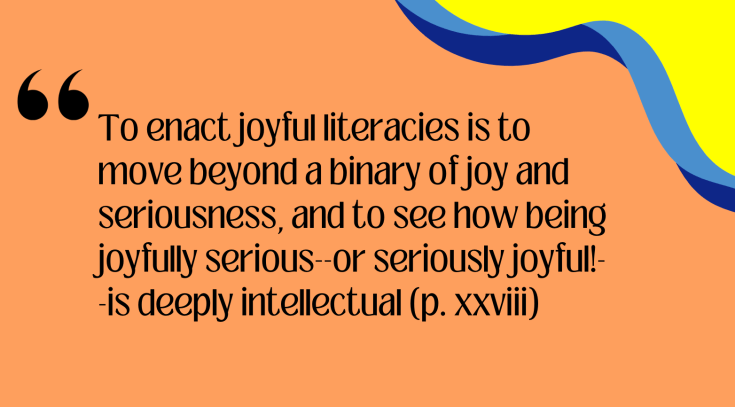
During our session, we asked our teacher audience to consider what they find joyful about the classroom, discussing what has brought them joy recently. We then review the essential question for the session: What are students’ joyful literacies? How can we engage our students in joyful practices by accessing their multiple literacies with the classroom? We think it’s important to align both the teacher’s joyful literacies and the students’ joyful literacies in the space of the learning environment. As teachers, we want our students to engage in research, in literacy, in collaborative inquiry, and our students often want choices that interest and engage them. In creating a lesson that centers pop culture, students create inquiry pathways that allow them to use some of their background knowledge and interests–such as a video game, a particular fashion, a moment in the zeitgeist–to conduct further research.
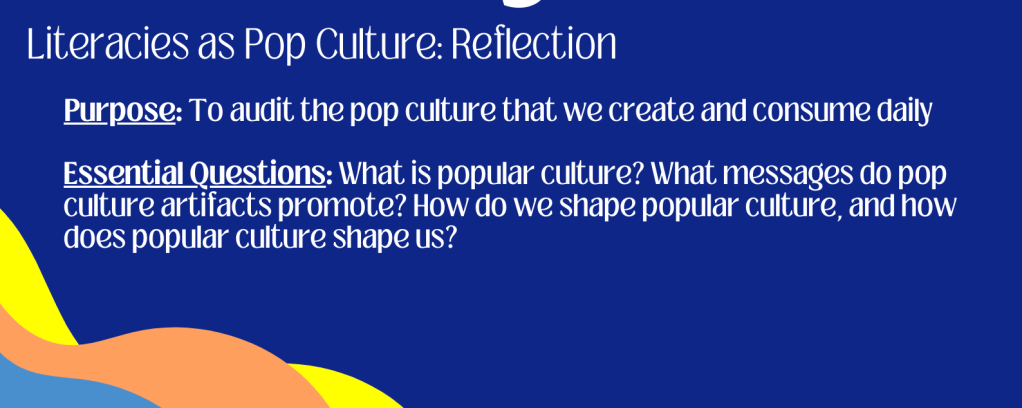
We then introduced the topic of pop culture by offering a student-driven purpose and essential questions. The book includes several from which teachers can choose and adapt beyond the ones we included in our session.
The first activity we shared was a graphic organizer that would help students begin to list their current pop culture obsessions. The idea is to give them 24 hours to collect and name the pop culture in which they are entrenched. The graphic organizer focuses on what the students consume in their daily lives–what they watch, wear, listen to, notice, and create.
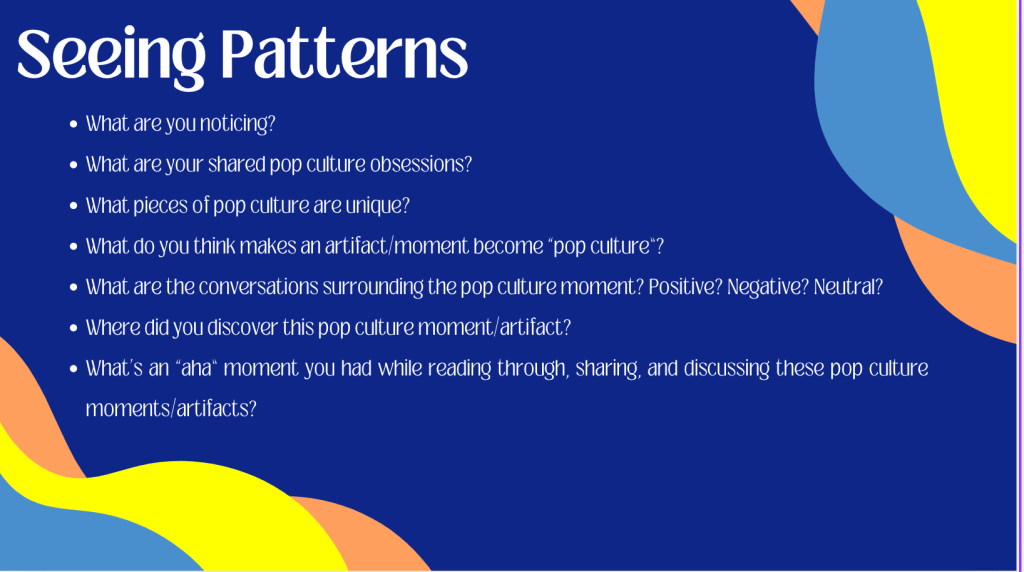
As teachers, we want students to begin thinking deeply about the ideas, values, and moments they consume unconsciously and consciously. Therefore, once they get their lists, we would ask them to share their obsessions and consider the patterns, the overlaps, and the revelations they have upon sharing their ideas and their pop culture moments with their groups.
We also think it’s essential to have students consider at least one pop culture obsession more deeply, so in the critical exploration stage, we ask them to reflect on one item from their lists–preferably one in which everyone has some interest. We ask them to consider the following questions, adapted from Shannon Falkner’s (2011) English Journal article about pop culture and writing.
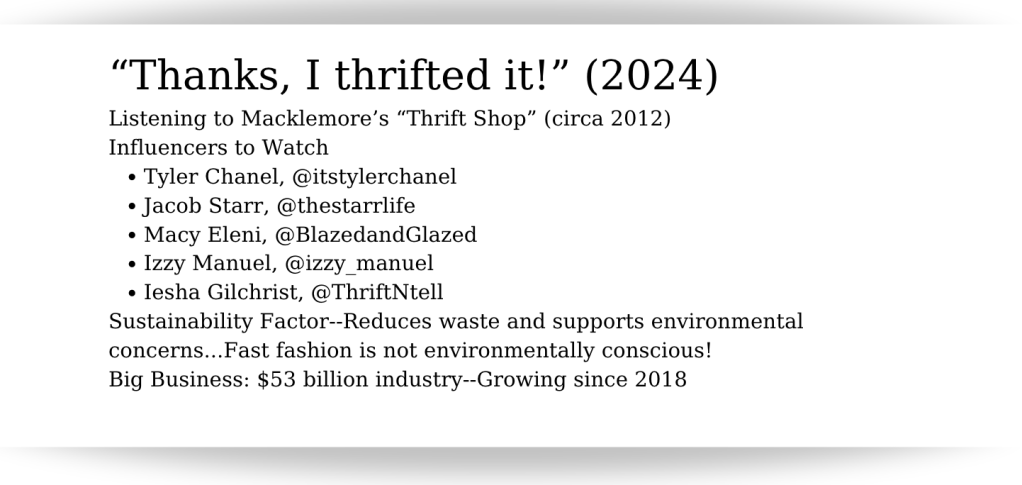
In the final stage of the unit, we ask students to research their shared pop culture moment and create a pop culture statement–like a museum placard–that lists important ideas and connections they’ve made through their research. We offered an example below of a pop culture obsession some of our students had recently–thrifting.
To be honest, it was a quick rundown of chapter seven of our book, which offers more activities and ways for students to research pop culture. We even wished we had an extended session to share these ideas with teachers. However, if this has piqued your interest, we hope you’ll check out the full chapter in our book Joyful Literacies in Secondary English Language Arts.
We are also offering a full look a the slideshow below, which includes links to graphic organizers and our examples, and our one-pager, which includes descriptions of our organizational structures and more info on the chapter. We hope you can use something from this brief overview in your classroom, and if you do, drop us a line or picture. We’ll post it on our Instagram account, @joyful_literacies. We hope this idea can help bring joy to you and your students!
 Joyful Literacies
Leave a comment